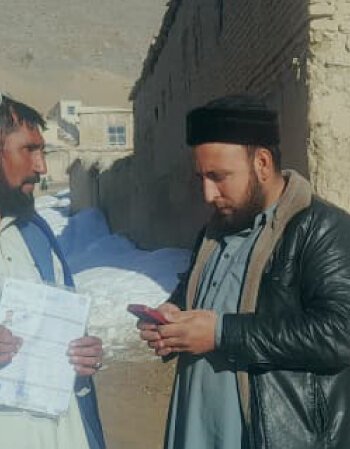

Adroit Associates implemented the Endline and Impact Evaluation of the Inclusive Livelihoods Recovery and Community Resilience in Afghanistan (FARAGIR) Project for Afghanaid across Badakhshan, Daykundi, Ghor, Jawzjan, Samangan, and Takhar provinces.
FARAGIR is an integrated livelihoods recovery and community resilience programme implemented by Afghanaid in partnership with Welthungerhilfe (WHH), Concern Worldwide (CWW), and Humanity & Inclusion (HI). The programme brings together food and nutrition security, inclusive livelihoods, climate-resilient agriculture, natural resource and watershed management, vocational skills, entrepreneurship, and social inclusion to strengthen the resilience of vulnerable rural households and communities.
Adroit's assignment covered a combined Endline and Impact Evaluation to assess project performance against intended objectives and outcomes, measure changes relative to baseline and midline conditions, examine the project's contribution to livelihood and resilience outcomes, and assess the sustainability of changes associated with the intervention.
Using a mixed-methods, participatory, and inclusive evaluation design, Adroit combined a structured household survey with Key Informant Interviews, Focus Group Discussions, document review, comparative analysis, and triangulation. The evaluation framework applied the six OECD-DAC criteria of Relevance, Coherence, Efficiency, Effectiveness, Impact, and Sustainability.
The assignment provides Afghanaid and its partners with evidence to understand project-level change, identify effective approaches and implementation lessons, assess sustainability, and strengthen the design of future inclusive livelihood and climate-resilience programming in Afghanistan.
The FARAGIR Project was established as an integrated response to interconnected livelihood, food-security, economic, environmental, and resilience challenges affecting rural communities across six provinces of Afghanistan.
Implemented by Afghanaid together with Welthungerhilfe, Concern Worldwide, and Humanity & Inclusion, the programme combined household-level livelihood support with longer-term approaches to agricultural productivity, economic participation, sustainable natural resource management, and community resilience.
Its interventions covered food security and dietary diversity; income generation and self-employment; access to financial services; vocational skills and entrepreneurship; climate-resilient agriculture; watershed and natural resource management; food preservation and nutrition; and support to small agribusinesses.
Inclusive participation formed an important dimension of the programme, including attention to women’s economic participation, persons with disabilities, youth, farmers, Self-Help Groups, and community-based structures.
Within this context, Adroit Associates was engaged to independently examine the extent to which FARAGIR achieved its intended results and to generate credible evidence on changes occurring between baseline, midline, and endline.
Project Objectives
Adroit’s assignment was designed to provide an independent assessment of FARAGIR’s performance, outcomes, impact, and sustainability across its six implementation provinces.
The evaluation examined progress against the project’s five interconnected areas of intervention: food security and household coping capacity; inclusive livelihoods and income opportunities; agricultural production and sustainable natural resource management; employment, entrepreneurship, and market participation; and climate-resilient agriculture, food preservation, and nutrition.
A central objective was to measure changes in key project indicators relative to available baseline and midline evidence, enabling Adroit to assess the direction and extent of change by the end of the programme.
The evaluation also examined how and why changes occurred, including the contextual and implementation factors influencing results. Particular attention was given to sustainability, inclusion, community participation, economic opportunities, agricultural resilience, and the experiences of different participant groups.
The assignment was further designed to identify lessons learned, good practices, implementation challenges, and actionable recommendations that could inform future programme design and decision-making.
Methodological Approach
Adroit Associates designed the evaluation around a mixed-methods, participatory, and inclusive methodology, integrating quantitative measurement with qualitative evidence to provide both measurable and contextual understanding of project results.
The quantitative component included a structured household survey across all six project provinces. The evaluation design established an endline sample of 631 households, supporting comparison with baseline and midline evidence while capturing geographic and participant diversity.
The qualitative component incorporated 48 Key Informant Interviews (KIIs) with implementing partners, project personnel, community representatives, and other relevant stakeholders.
Adroit’s methodology also included 48 Focus Group Discussions (FGDs) covering diverse participant groups, including women, men, persons with disabilities and other vulnerable groups, youth, farmers, agribusiness participants, Self-Help Groups, and community-based organizations.
A multistage sampling approach was designed to ensure representation across Badakhshan, Daykundi, Ghor, Jawzjan, Samangan, and Takhar, while allowing the analysis to capture differences between locations and participant groups.
The evaluation matrix was structured around the six OECD-DAC criteria — Relevance, Coherence, Efficiency, Effectiveness, Impact, and Sustainability—and complemented by analysis of lessons learned.
Adroit incorporated quality assurance throughout the evaluation process, including instrument review, pilot testing, field-team preparation, supervision, data cleaning, triangulation, and province-level analysis. Ethical safeguards included informed consent, confidentiality, Do No Harm principles, conflict-sensitive research practices, and appropriate protection of participant information.
Impact and Strategic Significance
Adroit’s evaluation was designed to generate evidence on FARAGIR’s contribution to livelihood recovery and community resilience at both household and community levels.
At household level, the assessment examined changes in food security, dietary diversity, coping capacity, income generation, employment and self-employment, financial access, agricultural production, and overall livelihood resilience.
At community and systems levels, the evaluation examined climate-resilient agricultural practices, watershed and natural resource management, participation in community structures, market and enterprise opportunities, social inclusion, and the sustainability of locally established mechanisms.
The evaluation’s inclusive design enabled Adroit to examine differences in participation and outcomes among women, men, persons with disabilities, youth, farmers, agribusiness participants, and other relevant groups rather than relying solely on aggregated project-level results.
By integrating endline evidence with baseline and midline data and triangulating quantitative findings with qualitative perspectives, Adroit’s work provides a stronger basis for understanding not only what changed, but also how and why those changes occurred.
The resulting evidence supports Afghanaid and its partners in assessing programme performance, demonstrating accountability, identifying sustainable approaches, strengthening organizational learning, and applying lessons from FARAGIR to future livelihood recovery, food security, economic inclusion, and climate-resilience programming.